Brass Electrodes

High Purity Cu Zn Electrodes


Product Product Code Order or Specifications
CU-90% ZN-10% BR-M-p.10ZN-EL Contact American Elements
CU-85% ZN-15% BR-M-p.15ZN-EL Contact American Elements
CU-80% ZN-20% BR-M-p.20ZN-EL Contact American Elements
CU-70% ZN-30% BR-M-p.30ZN-EL Contact American Elements
CU-65% ZN-35% BR-M-p.35ZN-EL Contact American Elements
CU-55% ZN-45% BR-M-p.45ZN-EL Contact American Elements

American Elements specializes in producing high purity uniform shaped Brass Electrodes with the highest possible density and smallest possible average grain sizes for use in semiconductor, Chemical Vapor Deposition (CVD) and Physical Vapor Deposition (PVD) processes including Thermal and Electron Beam (E-Beam) Evaporation, Low Temperature Organic Evaporation, Atomic Layer Deposition (ALD), Metallic-Organic and Chemical Vapor Deposition (MOCVD). American Elements produces high purity Brass Electrodes which can be used in chemical and physics experiments related to mass and heat conductivity or for demonstration purposes. Materials are produced using crystallization, solid state and other ultra high purification processes such as sublimation. American Elements specializes in producing custom compositions for commercial and research applications and for new proprietary technologies. American Elements casts any of the rare earth metals and most other advanced materials into rod, bar or plate form, as well as other machined shapes and through other processes such as nanoparticles (See also application discussion at Nanotechnology Information and at Quantum Dots) and in the form of solutions and organometallics. See safety data and research below and pricing/lead time above.

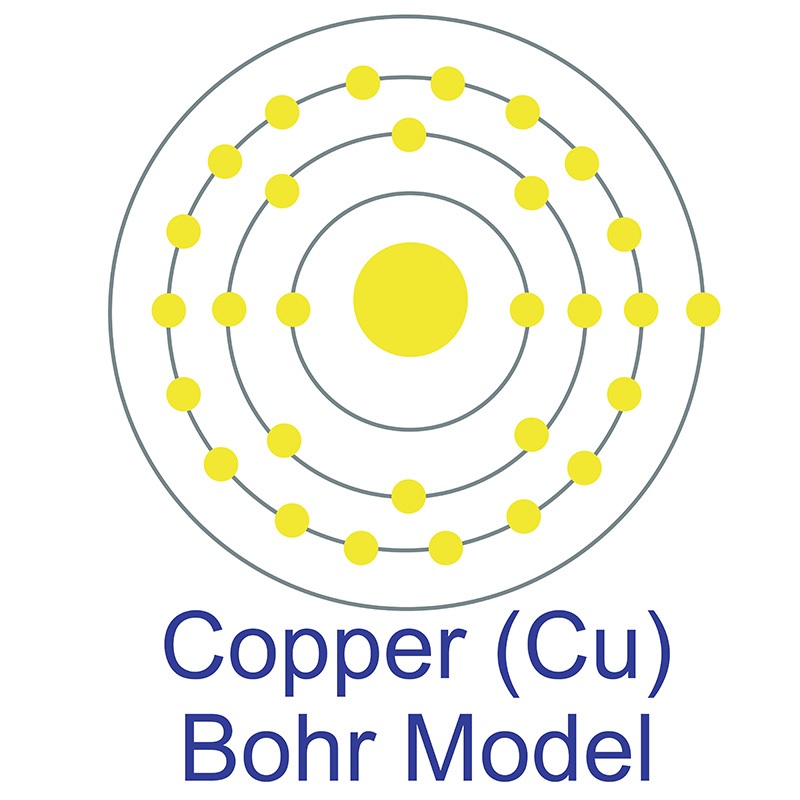
Copper(Cu) atomic and molecular weight, atomic number and elemental symbolCopper is a Block D, Group 11, Period 4 element. The number of electrons in each of Copper's shells is 2, 8, 18, 1 and its electronic configuration is [Ar] 3d10 4s1. In its elemental form copper's CAS number is 7440-50-8. The copper atom has a radius of 127.8 .pm and its Van der Waals radius is 140.pm. Copper is an essential trace element in animals and plants, but in excess copper is toxic. Due to its high electrical conductivity, large amounts of copper are used by the electrical industry for wire. Of all pure metals, only silver has a higher electrical conductivity. Recent research reveals that diluted magnetic semiconductors can be produced using Copper. Copper is also resistant to corrosion caused by moisture, making it a widely used material in pipes, coins, and jewelry. Copper is often too soft for its applications, so it is incorporated in numerous alloys. For example, brass is a copper-zinc alloy, and bronze is a copper-tin alloy. Copper Bohr Model Copper sulfate (CuSO4· H2O), also known as blue vitrol, is the most well-known copper compound. It is used as an agricultural poison, an algicide, and as a pigment for inks. Cuprous Elemental Copper chloride (CuCl) is a powder used to absorb carbon dioxide (CO2). Copper cyanide (CuCN) is often used in electroplating applications. Copper is available as metal and compounds with purities from 99% to 99.9999% (ACS grade to ultra-high purity); metals in the form of foil, sputtering target, and rod, and compounds as submicron and nanopowder. Copper was first discovered by Early Man. The origin of the word copper comes from the Latin word 'cuprium' which translates as "metal of Cyprus". Cyprus, a Mediterranean island, was known as an ancient source of mined copper. See Copper research below.

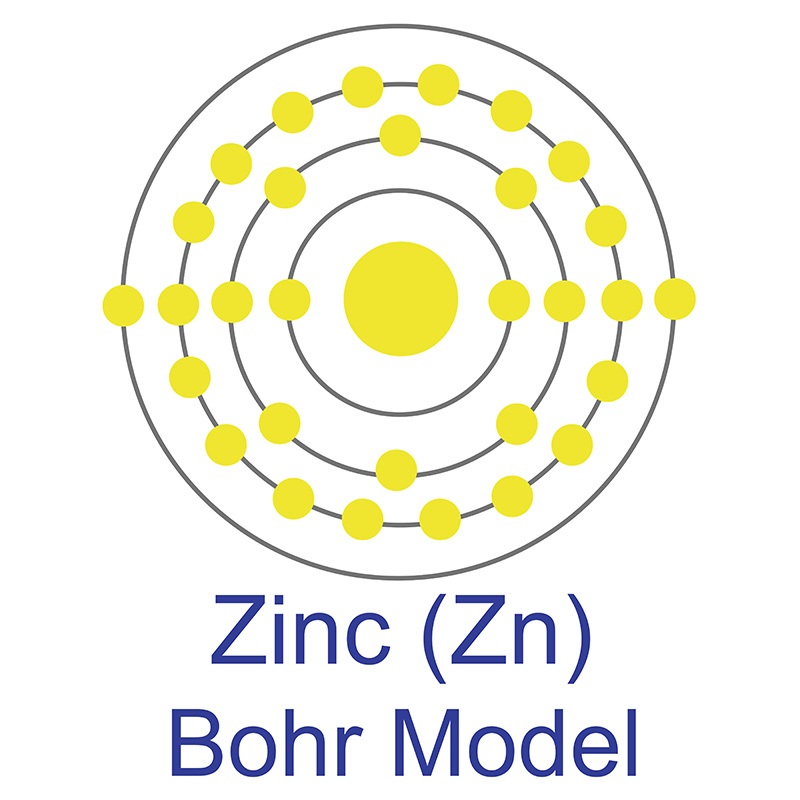
Zinc(Zn) atomic and molecular weight, atomic number and elemental symbolZinc is a Block D, Group 12, Period 4 element. The number of electrons in each of Zinc's shells is 2, 8, 18, 2, and its electronic configuration is [Ar] 3d10 4s2. In its elemental form zinc's CAS number is 7440-66-6. The zinc atom has a radius of 133.5.pm and its Van der Waals radius is 139.pm. Zinc is considered non-toxic in healthy doses but can cause nausea if taken in excess. Zinc is a bluish-white, lustrous metal which we produce in Special High Grade (SHG) purities. It is brittle at ordinary temperatures but malleable at 100 to 150 °C. It is a fair conductor of electricity, and burns in air at high red heat with evolution of white clouds of the oxide. It has unusual electrical, thermal, optical, and Zinc Bohr Modelsolid-state properties that have not been fully investigated. The metal is employed to form numerous alloys with other metals. Brass, Nickel, Silver, commercial Bronze, soft solder, and Aluminum solder are some of the more important alloys. Elemental Zinc Large quantities of zinc are used to produce die castings, which are used extensively by the automotive, electrical, and hardware industries. Zinc is also used extensively to galvanize other metals such as iron to prevent corrosion. Zinc oxide is widely used in the manufacture of paints, rubber products, cosmetics, pharmaceuticals, floor coverings, plastics, printing inks, soap, storage batteries, textiles, electrical equipment, and other products. Zinc sulfide is used in making luminous dials, X-ray and TV screens, and fluorescent lights The chloride and chromate are also important compounds. In a January 2013 report, researchers from Forschungszentrum Jülich, the University of Göttingen, Massachusetts Institute of Technology, Ruder Boškovic Institute, and IISER Kolkata used Zinc Methyl Phenalenyl (ZMP) and Cobalt to produce a new kind of molecular magnet. The new magnets could pave the way for more powerful storage media as well as faster and more energy-efficient processors for information processing. Zinc is available as metal and compounds with purities from 99% to 99.9999% (ACS grade to ultra-high purity); metals in the form of foil, sputtering target, and rod, and compounds as submicron and nanopowder. Zinc is mined from sulfidic ore deposits and is the fourth most common metal in use (after iron, aluminum, and copper). Zinc was first discovered by Andreas Marggraf in 1746. The element name Zinc originates from the German word "zin" meaning tin. See Zinc research below.


CUSTOMERS FOR BRASS ELECTRODES HAVE ALSO LOOKED AT
Show Me MORE Forms of Copper

PACKAGING SPECIFICATIONS FOR BULK & RESEARCH QUANTITIES
Typical bulk packaging includes palletized plastic 5 gallon/25 kg. pails, fiber and steel drums to 1 ton super sacks in full container (FCL) or truck load (T/L) quantities. Research and sample quantities and hygroscopic, oxidizing or other air sensitive materials may be packaged under argon or vacuum. Shipping documentation includes a Certificate of Analysis and Material Safety Data Sheet (MSDS). Solutions are packaged in polypropylene, plastic or glass jars up to palletized 440 gallon liquid totes.


Have a Question? Ask a Chemical Engineer or Material Scientist
Request an MSDS or Certificate of Analysis


*

*Search by Material, Product Name, Product Code, CAS Number, Formula, Element, Anion, Form, EC Number, MDL Number or PubChem ID.


German   Korean   French   Japanese   Spanish   Chinese (Simplified)   Portuguese   Russian   Chinese (Taiwan)  Italian   Turkish   Polish   Dutch   Czech   Swedish   Hungarian   Danish   Hebrew

Production Catalog Available in 36 Countries & Languages


Recent Research & Development for Copper

  • The Role of Copper in Disulfiram-Induced Toxicity and Radiosensitization of Cancer Cells. Rae C, Tesson M, Babich JW, Boyd M, Sorensen A, Mairs RJ. J Nucl Med. 2013 Apr 24.
  • Mechanistic Insights into Copper-Catalyzed Sonogashira-Hagihara-Type Cross-Coupling Reactions: Sub-Mol?% Catalyst Loadings and Ligand Effects. Zou LH, Johansson AJ, Zuidema E, Bolm C. Chemistry. 2013 Apr 24. doi: 10.1002/chem.201300480.
  • Directed Amination of Non-Acidic Arene C?H Bonds by a Copper-Silver Catalytic System. Tran LD, Roane J, Daugulis O. Angew Chem Int Ed Engl. 2013 Apr 24. doi: 10.1002/anie.201300135.
  • An Outbreak of Sodium Fluoroacetate (1080) Intoxication in Selenium- and Copper-Deficient Sheep in California. Giannitti F, Anderson M, Caspe SG, Mete A, East NE, Mostrom M, Poppenga R. Vet Pathol. 2013 Apr 23.
  • Biochemical, Histological, and Memory Impairment Effects of Chronic Copper Toxicity: A Model for Non-Wilsonian Brain Copper Toxicosis in Wistar Rat. Pal A, Badyal RK, Vasishta RK, Attri SV, Thapa BR, Prasad R. Biol Trace Elem Res. 2013 Apr 24.
  • Copper(ii) complexes with 2NO and 3N donor ligands: synthesis, structures and chemical nuclease and anticancer activities. Rajarajeswari C, Loganathan R, Palaniandavar M, Suresh E, Riyasdeen A, Akbarsha MA. Dalton Trans. 2013 Apr 24.
  • Prosopis pubescens (Screw Bean Mesquite) Seedlings are Hyperaccumulators of Copper. Zappala MN, Ellzey JT, Bader J, Peralta-Videa JR, Gardea-Torresdey J. Arch Environ Contam Toxicol. 2013 Apr 24.
  • Selective Formation of Secondary Amides via the Copper-Catalyzed Cross-Coupling of Alkylboronic Acids with Primary Amides. Rossi SA, Shimkin KW, Xu Q, Mori-Quiroz LM, Watson DA. Org Lett. 2013 Apr 23.
  • Templating and Charge Injection from Copper Electrodes into Solution-Processed Organic Field-Effect Transistors. Kim CH, Hlaing H, Carta F, Bonnassieux Y, Horowitz G, Kymissis I. ACS Appl Mater Interfaces. 2013 Apr 23.
  • Copper-Catalyzed Arylative Meyer-Schuster Rearrangement of Propargylic Alcohols to Complex Enones using Diaryliodonium Salts. Collins BS, Suero MG, Gaunt MJ. Angew Chem Int Ed Engl. 2013 Apr 22. doi: 10.1002/anie.201301529.
  • Photocatalytic Conversion of Carbon Dioxide with Water to Methane: Platinum and Copper(I) Oxide Co-catalysts with a Core-Shell Structure. Zhai Q, Xie S, Fan W, Zhang Q, Wang Y, Deng W, Wang Y. Angew Chem Int Ed Engl. 2013 Apr 22. doi: 10.1002/anie.201301473.
  • Effects of copper and vanadium deposition in multi-walled hydrogen trititanate and mixed-phase anatase/trititanate nanotubes. Caretti I, Zamani S, Beyers E, Cool P, Van Doorslaer S. Dalton Trans. 2013 Apr 22.
  • Effects of silicon and copper on bamboo grown hydroponically. Collin B, Doelsch E, Keller C, Panfili F, Meunier JD. Environ Sci Pollut Res Int. 2013 Apr 23.
  • Copper ligation to soluble oligomers of the English mutant of the amyloid-ß peptide yields a linear Cu(i) site that is resistant to O2 oxidation. Peck KL, Clewett HS, Schmitt JC, Shearer J. Chem Commun (Camb). 2013 Apr 23.
  • Copper deficiency: A potential model for determining the role of mitochondria in cardiac aging. Johnson WT, Newman SM Jr. J Am Aging Assoc. 2003 Jan;26(1-2):19-28. doi: 10.1007/s11357-003-0003-x.
  • Copper Salts as Additives in Gold(I)-Catalyzed Reactions. Guérinot A, Fang W, Sircoglou M, Bour C, Bezzenine-Lafollée S, Gandon V. Angew Chem Int Ed Engl. 2013 Apr 19. doi: 10.1002/anie.201300600.
  • TOXICITY AND METAL BIOACCUMULATION IN HORDEUM VULGARE EXPOSED TO LEACHED AND NON-LEACHED COPPER AMENDED SOILS. Schwertfeger DM, Hendershot WH. Environ Toxicol Chem. 2013 Apr 18. doi: 10.1002/etc.2242.
  • Effect of aluminium and copper on biofilm development of Pseudomonas pseudoalcaligenes KF707 and P. fluorescens as a function of different media compositions. Booth SC, George IF, Zannoni D, Cappelletti M, Duggan GE, Ceri H, Turner RJ. Metallomics. 2013 Apr 22.
  • Effect of sublethal concentrations of waterborne copper on lipid peroxidation and enzymatic antioxidant response in Gambusia holbrooki. Sáez MI, García-Mesa S, Casas JJ, Guil-Guerrero JL, Venegas-Venegas CE, Morales AE, Suárez MD. Environ Toxicol Pharmacol. 2013 Mar 28;36(1):125-134. doi: 10.1016/j.etap.2013.03.011.
  • A fluorometric assay for acetylcholinesterase activity and inhibitor detection based on DNA-templated copper/silver nanoclusters. Li W, Li W, Hu Y, Xia Y, Shen Q, Nie Z, Huang Y, Yao S. Biosens Bioelectron. 2013 Mar 27;47C:345-349. doi: 10.1016/j.bios.2013.03.038.

Recent Research & Development for Zinc

  • catena-Poly[[[bis-(4-pyridine-aldoxime-?N (1))zinc]-µ-benzene-1,4-dicarboxyl-ato-?(2) O (1):O (4)] 4-pyridine-aldoxime monosolvate]. Kumagai H, Kawata S, Sakamoto Y. Acta Crystallogr Sect E Struct Rep Online. 2013 Mar 16;69(Pt 4):m216. doi: 10.1107/S1600536813006107. Print 2013 Apr 1.
  • Diaqua-bis-{5-(pyridin-2-yl-?N)-3-[4-(pyri-din-4-yl)phenyl]-1H-1,2,4-triazol-1-ido-?N (1)}zinc. Li B. Acta Crystallogr Sect E Struct Rep Online. 2013 Mar 16;69(Pt 4):m214. doi: 10.1107/S1600536813005916. Print 2013 Apr 1.
  • trans-Tetra-aqua-bis-(isonicotinamide-?N (1))zinc bis-(3-hy-droxy-benzoate) tetra-hydrate. Zaman IG, Caylak Delibas N, Necefoglu H, Hökelek T. Acta Crystallogr Sect E Struct Rep Online. 2013 Mar 13;69(Pt 4):m198-9. doi: 10.1107/S1600536813006466. Print 2013 Apr 1.
  • Activation of CO2 by tBuZnOH species: efficient routes to novel nanomaterials based on zinc carbonates. Sokolowski K, Bury W, Justyniak I, Cieslak AM, Wolska M, Soltys K, Dziecielewski I, Lewinski J. Chem Commun (Camb). 2013 May 1.
  • Expanding the Repertoire of Target Sites for Zinc Finger Nuclease-mediated Genome Modification. Wilson KA, McEwen AE, Pruett-Miller SM, Zhang J, Kildebeck EJ, Porteus MH. Mol Ther Nucleic Acids. 2013 Apr 30;2:e88. doi: 10.1038/mtna.2013.13.
  • Genome-wide transcriptional responses of two metal-tolerant symbiotic Mesorhizobium isolates to Zinc and Cadmium exposure. Maynaud G, Brunel B, Mornico D, Durot M, Severac D, Dubois E, Navarro E, Cleyet-Marel JC, Le Quéré A. BMC Genomics. 2013 Apr 30;14(1):292.
  • A one-dimensional zinc(II) coordination polymer incorporating [1,1'-biphenyl]-4,4'-dicarboxylate and N,N'-bis(pyridin-3-ylmethyl)-[1,1'-biphenyl]-4,4'-dicarboxamide ligands. Zhou W, Wang J. Acta Crystallogr C. 2013 May;69(Pt 5):486-90. doi: 10.1107/S0108270113008111. 2013 Apr 9.
  • Binuclear and chain-structure zinc(II) complexes constructed from 3,4-dimethoxy-trans-cinnamic acid and N-donor coligands 4-(1H-pyrazol-3-yl)pyridine and 4,4'-bipyridine. Wang YL, Shao ZJ, Qian SS. Acta Crystallogr C. 2013 May;69(Pt 5):471-5. doi: 10.1107/S0108270113007075. 2013 Apr 9.
  • Local electronic structure of aqueous zinc acetate: oxygen K-edge X-ray absorption and emission spectroscopy on micro-jets. Golnak R, Atak K, Suljoti E, Hodeck KF, Lange KM, Soldatov MA, Engel N, Aziz EF. Phys Chem Chem Phys. 2013 Apr 30.
  • Synthesis of antibacterial surfaces by plasma grafting of zinc oxide based nanocomposites onto polypropylene. de Rancourt Y, Couturaud B, Mas A, Robin JJ. J Colloid Interface Sci. 2013 Apr 9. doi:pii: S0021-9797(13)00276-2. 10.1016/j.jcis.2013.03.031.
  • Understanding morphology-controlled synthesis of zinc nanoparticles and their characteristics of hydrolysis reaction. Mun B, Lee D. Langmuir. 2013 Apr 29.
  • A Quantitative Structure-Activity Relationship Study on a Series of Selective Non-zinc Binding Inhibitors of MMP13. Singh P. Med Chem. 2013 Apr 25.
  • Antidiabetic and Pancreas-Protective Effects of Zinc Threoninate Chelate in Diabetic Rats may be Associated with its Antioxidative Stress Ability. Zhu K, Nie S, Li C, Huang J, Hu X, Li W, Gong D, Xie M. Biol Trace Elem Res. 2013 Apr 27.
  • Iron and zinc complexation in wild-type and ferritin-expressing wheat grain: implications for mineral transport into developing grain. Neal AL, Geraki K, Borg S, Quinn P, Mosselmans JF, Brinch-Pedersen H, Shewry PR. J Biol Inorg Chem. 2013 Apr 27.
  • Mobility, bioavailability and pH-dependent leaching of cadmium, zinc and lead in a contaminated soil amended with biochar. Houben D, Evrard L, Sonnet P. Chemosphere. 2013 Apr 23. doi:pii: S0045-6535(13)00485-2. 10.1016/j.chemosphere.2013.03.055.
  • Integrated and Passive 1,2,3-Triazolyl Groups in Fluorescent Indicators for Zinc(II) Ions: Thermodynamic and Kinetic Evaluations. Simmons JT, Allen JR, Morris DR, Clark RJ, Levenson CW, Davidson MW, Zhu L. Inorg Chem. 2013 Apr 26.
  • Asymmetric zinc-catalyzed hydrosilylation of ketones and the effect of carboxylate on the enantioselectivity. Pang S, Peng J, Li J, Bai Y, Xiao W, Lai G. Chirality. 2013 May;25(5):275-80. doi: 10.1002/chir.22137.
  • Single-pot synthesis of zinc nanoparticles, borane (BH3) and closo-dodecaborate (B12H12)2- using LiBH4 under mild conditions. Ghanta SR, Rao MH, Muralidharan K. Dalton Trans. 2013 Apr 25.
  • Zinc modulation of calcium activity at the photoreceptor terminal: A calcium imaging study. Anastassov I, Shen W, Ripps H, Chappell RL. Exp Eye Res. 2013 Apr 22. doi:pii: S0014-4835(13)00099-7. 10.1016/j.exer.2013.04.011.
  • DNA binding specificities of the long zinc finger recombination protein PRDM9. Billings T, Parvanov ED, Baker CL, Walker M, Paigen K, Petkov PM. Genome Biol. 2013 Apr 24;14(4):R35.