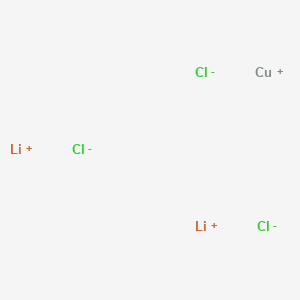
Copper(I) Chloride - Bis(Lithium Chloride) Complex
CuCl • (LiCl)2
1 M in THF
| CHEMICAL IDENTIFIER |
Formula | CAS No. | PubChem SID | PubChem CID | MDL No. | EC No | IUPAC Name | Beilstein Re. No. |
SMILES Identifier |
InChI Identifier |
InChI Key |
|---|---|---|---|---|---|---|---|---|---|---|---|
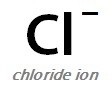
| CuCl • (LiCl)2 | N/A | 45624508 | 9877549 | N/A | N/A | dilithium; copper(1+); trichloride | N/A | Li+].[Li+].[Cl-]. [Cl-].[Cl-].[Cu+] |
InChI=1S/3ClH.Cu. 2Li/h3*1H;;;/q;;;3*+1/p-3 |
QJRAZNXUNZEAQH-UHFFFAOYSA-K |
| PROPERTIES | Compound Formula | Mol. Wt. | Appearance | Melting Point | Boiling Point | Density | Monoisotopic Mass | Charge | MSDS | |
|---|---|---|---|---|---|---|---|---|---|---|
| Li2Cl3Cu | 183.79 | Brown-yellow to yellow-green liquid | N/A | N/A | 1.015 g/mL | 181.868165 | 181.868165 | 0 | Safety Data Sheet |
Copper(I) Chloride - Bis(Lithium Chloride) Complex is generally immediately available in most volumes. High purity, submicron and nanopowder forms may be considered. American Elements produces to many standard grades when applicable, including Mil Spec (military grade); ACS, Reagent and Technical Grade; Food, Agricultural and Pharmaceutical Grade; Optical Grade, USP and EP/BP (European Pharmacopoeia/British Pharmacopoeia) and follows applicable ASTM testing standards. Typical and custom packaging is available. Additional technical, research and safety (MSDS) information is available as is a Reference Calculator for converting relevant units of measurement.
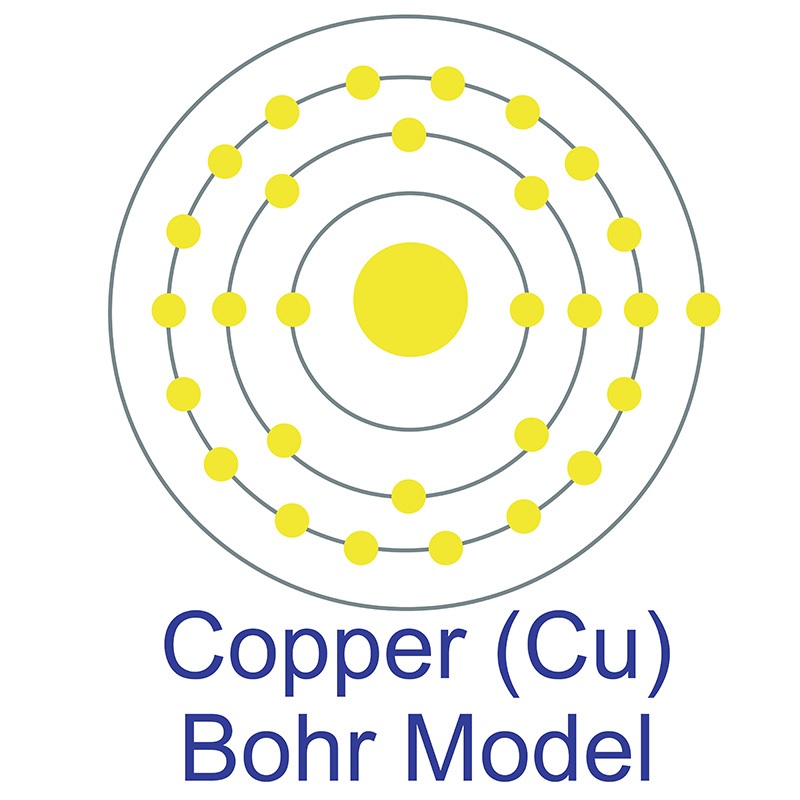
Copper is a Block D, Group 11, Period 4 element. The number of electrons in each of Copper's shells is 2, 8, 18, 1 and its electronic configuration is [Ar] 3d10 4s1. In its elemental form copper's CAS number is 7440-50-8. The copper atom has a radius of 127.8 .pm and its Van der Waals radius is 140.pm. Copper is an essential trace element in animals and plants, but in excess copper is toxic. Due to its high electrical conductivity, large amounts of copper are used by the electrical industry for wire. Of all pure metals, only silver has a higher electrical conductivity. Recent research reveals that diluted magnetic semiconductors can be produced using Copper. Copper is also resistant to corrosion caused by moisture, making it a widely used material in pipes, coins, and jewelry. Copper is often too soft for its applications, so it is incorporated in numerous alloys. For example, brass is a copper-zinc alloy, and bronze is a copper-tin alloy.
Copper sulfate (CuSO4· H2O), also known as blue vitrol, is the most well-known copper compound. It is used as an agricultural poison, an algicide, and as a pigment for inks. Cuprous
chloride (CuCl) is a powder used to absorb carbon dioxide (CO2). Copper cyanide (CuCN) is often used in electroplating applications. Copper is available as metal and compounds with purities from 99% to 99.9999% (ACS grade to ultra-high purity); metals in the form of foil, sputtering target, and rod, and compounds as submicron and nanopowder. Copper was first discovered by Early Man. The origin of the word copper comes from the Latin word 'cuprium' which translates as "metal of Cyprus". Cyprus, a Mediterranean island, was known as an ancient source of mined copper. See Copper research below.
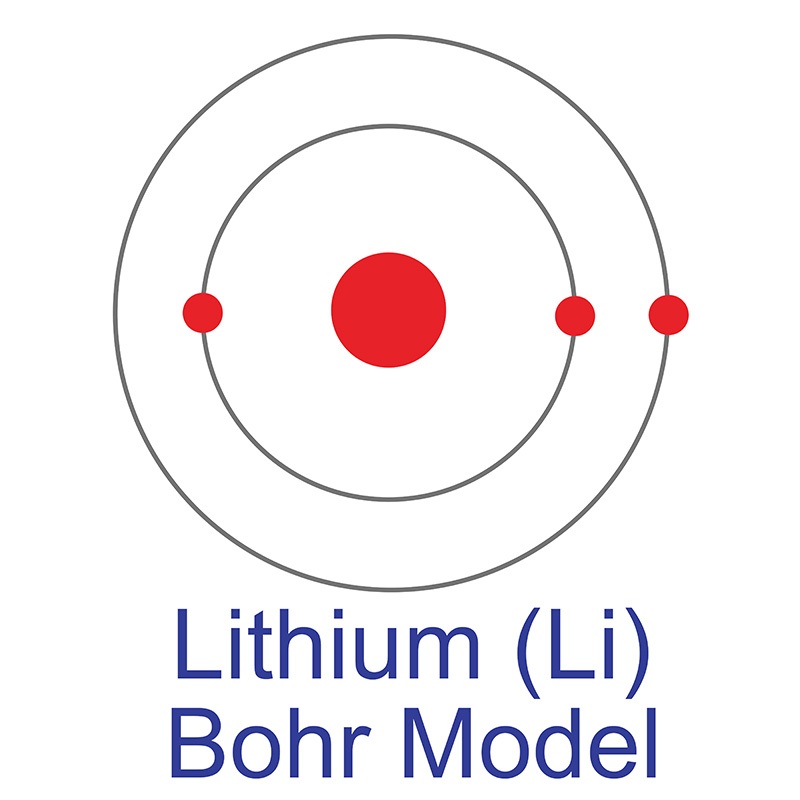
Lithium is a Block S, Group 1, Period 2 element. The number of electrons in each of Lithium's shells is 2, 1 and its electronic configuration is [He] 2s1. In its elemental form lithium's CAS number is 7439-93-2. The lithium atom has a radius of 152.pm and its Van der Waals radius is 182.pm. Lithium is toxic and corrosive. Lithium is a member of the alkali group of metals. It has the highest specific heat and electrochemical potential of any material, making it important in applications involving heat transfer and as the anode in batteries.
In a recent report, the Institute of Electric and Electronics Engineers (IEEE) predicted that Lithium ion battery technology will be key to developing grid-level energy storage solutions as the demand for solar, wind, and other renewable energy sources rises during the next five years. Lithium is available as metal and compounds with purities from 99% to
99.999% (ACS grade to ultra-high purity); metals in the form of foil, sputtering target, and rod, and compounds as submicron and nanopowder. Lithium is a dopant in advanced optical glass. It is used as an alloy in light weight metals. Lithium stearate is a common high temperature lubricant. Because of its high reactivity, Lithium does not occur naturally in elemental form. Lithium was first discovered by Johann Arvedson in 1817. The origin of the name Lithium comes from the Greek word lithose which means "stone". See Lithium research below.
| HEALTH, SAFETY & TRANSPORTATION INFORMATION | |||||
|---|---|---|---|---|---|
| Material Safety Data Sheet | MSDS | ||||
| Signal Word | N/A | ||||
| Hazard Statements | N/A | ||||
| Hazard Codes | F,Xn | ||||
| Risk Codes | 11-19-36/37-51/53 | ||||
| Safety Precautions | 26-60-61 | ||||
| RTECS Number | N/A | ||||
| Transport Information | UN 1993 3/PG 2 | ||||
| WGK Germany | N/A | ||||
| Globally Harmonized System of Classification and Labelling (GHS) |
N/A | ||||
CUSTOMERS FOR COPPER(I) CHLORIDE - BIS(LITHIUM CHLORIDE) COMPLEX HAVE ALSO LOOKED AT |
||||
|---|---|---|---|---|
| Show Me MORE Forms of Copper | ||||
PACKAGING SPECIFICATIONS FOR BULK & RESEARCH QUANTITIES |
|---|
| Typical bulk packaging includes palletized plastic 5 gallon/25 kg. pails, fiber and steel drums to 1 ton super sacks in full container (FCL) or truck load (T/L) quantities. Research and sample quantities and hygroscopic, oxidizing or other air sensitive materials may be packaged under argon or vacuum. Shipping documentation includes a Certificate of Analysis and Material Safety Data Sheet (MSDS). Solutions are packaged in polypropylene, plastic or glass jars up to palletized 440 gallon liquid totes. |
|
|
Recent Research & Development for Copper
- The Role of Copper in Disulfiram-Induced Toxicity and Radiosensitization of Cancer Cells. Rae C, Tesson M, Babich JW, Boyd M, Sorensen A, Mairs RJ. J Nucl Med. 2013 Apr 24.
- Mechanistic Insights into Copper-Catalyzed Sonogashira-Hagihara-Type Cross-Coupling Reactions: Sub-Mol?% Catalyst Loadings and Ligand Effects. Zou LH, Johansson AJ, Zuidema E, Bolm C. Chemistry. 2013 Apr 24. doi: 10.1002/chem.201300480.
- Directed Amination of Non-Acidic Arene C?H Bonds by a Copper-Silver Catalytic System. Tran LD, Roane J, Daugulis O. Angew Chem Int Ed Engl. 2013 Apr 24. doi: 10.1002/anie.201300135.
- An Outbreak of Sodium Fluoroacetate (1080) Intoxication in Selenium- and Copper-Deficient Sheep in California. Giannitti F, Anderson M, Caspe SG, Mete A, East NE, Mostrom M, Poppenga R. Vet Pathol. 2013 Apr 23.
- Biochemical, Histological, and Memory Impairment Effects of Chronic Copper Toxicity: A Model for Non-Wilsonian Brain Copper Toxicosis in Wistar Rat. Pal A, Badyal RK, Vasishta RK, Attri SV, Thapa BR, Prasad R. Biol Trace Elem Res. 2013 Apr 24.
- Copper(ii) complexes with 2NO and 3N donor ligands: synthesis, structures and chemical nuclease and anticancer activities. Rajarajeswari C, Loganathan R, Palaniandavar M, Suresh E, Riyasdeen A, Akbarsha MA. Dalton Trans. 2013 Apr 24.
- Prosopis pubescens (Screw Bean Mesquite) Seedlings are Hyperaccumulators of Copper. Zappala MN, Ellzey JT, Bader J, Peralta-Videa JR, Gardea-Torresdey J. Arch Environ Contam Toxicol. 2013 Apr 24.
- Selective Formation of Secondary Amides via the Copper-Catalyzed Cross-Coupling of Alkylboronic Acids with Primary Amides. Rossi SA, Shimkin KW, Xu Q, Mori-Quiroz LM, Watson DA. Org Lett. 2013 Apr 23.
- Templating and Charge Injection from Copper Electrodes into Solution-Processed Organic Field-Effect Transistors. Kim CH, Hlaing H, Carta F, Bonnassieux Y, Horowitz G, Kymissis I. ACS Appl Mater Interfaces. 2013 Apr 23.
- Copper-Catalyzed Arylative Meyer-Schuster Rearrangement of Propargylic Alcohols to Complex Enones using Diaryliodonium Salts. Collins BS, Suero MG, Gaunt MJ. Angew Chem Int Ed Engl. 2013 Apr 22. doi: 10.1002/anie.201301529.
- Photocatalytic Conversion of Carbon Dioxide with Water to Methane: Platinum and Copper(I) Oxide Co-catalysts with a Core-Shell Structure. Zhai Q, Xie S, Fan W, Zhang Q, Wang Y, Deng W, Wang Y. Angew Chem Int Ed Engl. 2013 Apr 22. doi: 10.1002/anie.201301473.
- Effects of copper and vanadium deposition in multi-walled hydrogen trititanate and mixed-phase anatase/trititanate nanotubes. Caretti I, Zamani S, Beyers E, Cool P, Van Doorslaer S. Dalton Trans. 2013 Apr 22.
- Effects of silicon and copper on bamboo grown hydroponically. Collin B, Doelsch E, Keller C, Panfili F, Meunier JD. Environ Sci Pollut Res Int. 2013 Apr 23.
- Copper ligation to soluble oligomers of the English mutant of the amyloid-ß peptide yields a linear Cu(i) site that is resistant to O2 oxidation. Peck KL, Clewett HS, Schmitt JC, Shearer J. Chem Commun (Camb). 2013 Apr 23.
- Copper deficiency: A potential model for determining the role of mitochondria in cardiac aging. Johnson WT, Newman SM Jr. J Am Aging Assoc. 2003 Jan;26(1-2):19-28. doi: 10.1007/s11357-003-0003-x.
- Copper Salts as Additives in Gold(I)-Catalyzed Reactions. Guérinot A, Fang W, Sircoglou M, Bour C, Bezzenine-Lafollée S, Gandon V. Angew Chem Int Ed Engl. 2013 Apr 19. doi: 10.1002/anie.201300600.
- TOXICITY AND METAL BIOACCUMULATION IN HORDEUM VULGARE EXPOSED TO LEACHED AND NON-LEACHED COPPER AMENDED SOILS. Schwertfeger DM, Hendershot WH. Environ Toxicol Chem. 2013 Apr 18. doi: 10.1002/etc.2242.
- Effect of aluminium and copper on biofilm development of Pseudomonas pseudoalcaligenes KF707 and P. fluorescens as a function of different media compositions. Booth SC, George IF, Zannoni D, Cappelletti M, Duggan GE, Ceri H, Turner RJ. Metallomics. 2013 Apr 22.
- Effect of sublethal concentrations of waterborne copper on lipid peroxidation and enzymatic antioxidant response in Gambusia holbrooki. Sáez MI, García-Mesa S, Casas JJ, Guil-Guerrero JL, Venegas-Venegas CE, Morales AE, Suárez MD. Environ Toxicol Pharmacol. 2013 Mar 28;36(1):125-134. doi: 10.1016/j.etap.2013.03.011.
- A fluorometric assay for acetylcholinesterase activity and inhibitor detection based on DNA-templated copper/silver nanoclusters. Li W, Li W, Hu Y, Xia Y, Shen Q, Nie Z, Huang Y, Yao S. Biosens Bioelectron. 2013 Mar 27;47C:345-349. doi: 10.1016/j.bios.2013.03.038.
Recent Research & Development for Lithium
- Infiltrating sulfur in hierarchical architecture MWCNT@meso C core-shell nanocomposites for lithium-sulfur batteries. Wang D, Yu Y, Zhou W, Chen H, Disalvo FJ, Muller DA, Abruña HD. Phys Chem Chem Phys. 2013 May 10.
- Highly Reversible Lithium Storage in Hierarchical Ca2 Ge7 O16 Nanowire Arrays/Carbon Textile Anodes. Li W, Wang X, Liu B, Luo S, Liu Z, Hou X, Xiang Q, Chen D, Shen G. Chemistry. 2013 May 9. doi: 10.1002/chem.201300115.
- Calculation of characteristics of nonlinear normal waves in plates of lithium niobate for the designing of acousto-electronic devices. Kuslyva A, Storozhev V. J Acoust Soc Am. 2013 May;133(5):3412. doi: 10.1121/1.4805962.
- Synergistic Effect of SnO2 /ZnWO4 Core-Shell Nanorods with High Reversible Lithium Storage Capacity. Xing LL, Yuan S, He B, Zhao YY, Wu XL, Xue XY. Chem Asian J. 2013 May 7. doi: 10.1002/asia.201300337.
- Pyrolyzed Bacterial Cellulose: A Versatile Support for Lithium Ion Battery Anode Materials. Wang B, Li X, Luo B, Yang J, Wang X, Song Q, Chen S, Zhi L. Small. 2013 May 8. doi: 10.1002/smll.201300692.
- Lithium normalizes amphetamine-induced changes in striatal FoxO1 phosphorylation and behaviors in rats. Zheng W, Zeng Z, Bhardwaj SK, Jamali S, Srivastava LK. Neuroreport. 2013 May 4.
- A reversible long-life lithium-air battery in ambient air. Zhang T, Zhou H. Nat Commun. 2013;4:1817. doi: 10.1038/ncomms2855.
- Nephroprotective effect of GSK-3ß inhibition by lithium ions and d-opioid receptor agonist dalargin on gentamicin-induced nephrotoxicity. Plotnikov EY, Grebenchikov OA, Babenko VA, Pevzner IB, Zorova LD, Likhvantsev VV, Zorov DB. Toxicol Lett. 2013 May 4. doi:pii: S0378-4274(13)00178-1. 10.1016/j.toxlet.2013.04.023.
- Rational Design of Anode Materials Based on Group IVA Elements (Si, Ge, and Sn) for Lithium-Ion Batteries. Wu XL, Guo YG, Wan LJ. Chem Asian J. 2013 May 6. doi: 10.1002/asia.201300279.
- Accurate Control of Multishelled Co3 O4 Hollow Microspheres as High-Performance Anode Materials in Lithium-Ion Batteries. Wang J, Yang N, Tang H, Dong Z, Jin Q, Yang M, Kisailus D, Zhao H, Tang Z, Wang D. Angew Chem Int Ed Engl. 2013 May 6. doi: 10.1002/anie.201301622.
- Versatile Reactivity of a Lithium Tris(aryl)plumbate(II) towards Organolanthanoid Compounds: Stable Lead-Lanthanoid-Metal Bonds or Redox Processes. Zeckert K, Griebel J, Kirmse R, Weiß M, Denecke R. Chemistry. 2013 May 3. doi: 10.1002/chem.201300596.
- In-depth safety-focused analysis of solvents used in electrolytes for large scale lithium ion batteries. Eshetu GG, Grugeon S, Laruelle S, Boyanov S, Lecocq A, Bertrand JP, Marlair G. Phys Chem Chem Phys. 2013 May 7.
- Topochemical transformation route to atomically thick Co3O4 nanosheets realizing enhanced lithium storage performance. Zhu J, Bai L, Sun Y, Zhang X, Li Q, Cao B, Yan W, Xie Y. Nanoscale. 2013 May 7.
- Preparation and Exceptional Lithium Anodic Performance of Porous Carbon-Coated ZnO Quantum Dots Derived from a Metal-Organic Framework. Yang SJ, Nam S, Kim T, Im JH, Jung H, Kang JH, Wi S, Park B, Park CR. J Am Chem Soc. 2013 May 9.
- Shape controlled hydrothermal synthesis and characterization of LiFePO4 for lithium ion batteries. Yu Y, Li Q, Ma Y, Zhang X, Zhu Y, Qian Y. J Nanosci Nanotechnol. 2013 Feb;13(2):1515-9.
- CuS nanoflakes, microspheres, microflowers, and nanowires: synthesis and lithium storage properties. Zhang B, Gao XW, Wang JZ, Chou SL, Konstantinov K, Liu HK. J Nanosci Nanotechnol. 2013 Feb;13(2):1309-16.
- Facile synthesis and application of CuS nanospheres in aqueous and organic lithium ion batteries. Li Q, Xue Y, Zhu Y, Qian Y. J Nanosci Nanotechnol. 2013 Feb;13(2):1265-9.
- ß-MnO2 as a cathode material for lithium ion batteries from first principles calculations. Wang D, Liu LM, Zhao SJ, Li BH, Liu H, Lang XF. Phys Chem Chem Phys. 2013 May 3.
- A simple reduction process to synthesize MoO2/C composites with cage-like structure for high-performance lithium-ion batteries. Liu B, Zhao X, Tian Y, Zhao D, Hu C, Cao M. Phys Chem Chem Phys. 2013 May 3.
- Thermoluminescence responses of photon- and electron-irradiated lithium potassium borate co-doped with Cu+Mg or Ti+Mg. Alajerami YS, Hashim S, Ramli AT, Saleh MA, Saripan MI, Alzimami K, Min Ung N. Appl Radiat Isot. 2013 Apr 9;78C:21-25. doi: 10.1016/j.apradiso.2013.03.095.
Recent Research & Development for Chlorides
- Synthesis and structures of hypervalent organoantimony and organobismuth chlorides containing asymmetric C,E,C-chelating (E = O, S) ligands. Tan N, Chen Y, Yin SF, Qiu R, Zhou Y, Au CT. Dalton Trans. 2013 May 10. [Epub ahead of print]
- Fe-containing ionic liquids as effective and recoverable oxidants for dissolution of UO2 in the presence of imidazolium chlorides. Yao A, Chu T. Dalton Trans. 2013 Apr 25. [Epub ahead of print]
- Synthesis and in vitro antimicrobial activity of 1-methyl-3-sulfonylthio-4-aminoquinolinium chlorides. Zieba A, Wojtyczka RD, Idzik D, Kepa M. Acta Pol Pharm. 2013 Jan-Feb;70(1):163-6.
- Palladium-catalyzed formal hydroacylation of allenes employing Acid chlorides and hydrosilanes. Fujihara T, Tatsumi K, Terao J, Tsuji Y. Org Lett. 2013 May 3;15(9):2286-9. doi: 10.1021/ol400862k. Epub 2013 Apr 22.
- High-spin binuclear cyclopentadienyliron chlorides: a density functional theory study. Wang C, Zhang X, Bai Y, Gao F, Li Q. J Mol Model. 2013 Apr 18. [Epub ahead of print]
- Palladacycle-Catalyzed Decarboxylative Coupling of Alkynyl Carboxylic Acids with Aryl Chlorides under Air. Li X, Yang F, Wu Y. J Org Chem. 2013 May 3;78(9):4543-50. doi: 10.1021/jo400574d. Epub 2013 Apr 22.
- Palladium-catalyzed desulfitative cross-coupling reaction of sodium sulfinates with benzyl chlorides. Zhao F, Tan Q, Xiao F, Zhang S, Deng GJ. Org Lett. 2013 Apr 5;15(7):1520-3. doi: 10.1021/ol400295z. Epub 2013 Mar 13.
- Synthesis, characterization and catalytic behavior toward ethylene of 2-[1-(4,6-dimethyl-2-benzhydrylphenylimino)ethyl]-6-[1-(arylimino)ethyl]pyridylmetal (iron or cobalt) chlorides. Wang S, Li B, Liang T, Redshaw C, Li Y, Sun WH. Dalton Trans. 2013 Mar 27. [Epub ahead of print]
- N-Heterocyclic carbene-palladium catalysts for the direct arylation of pyrrole derivatives with aryl chlorides. Ozdemir I, Gürbüz N, Kaloglu N, Dogan O, Kaloglu M, Bruneau C, Doucet H. Beilstein J Org Chem. 2013;9:303-12. doi: 10.3762/bjoc.9.35. Epub 2013 Feb 12.
- Expanded ring diaminocarbene palladium complexes: synthesis, structure, and Suzuki-Miyaura cross-coupling of heteroaryl chlorides in water. Kolychev EL, Asachenko AF, Dzhevakov PB, Bush AA, Shuntikov VV, Khrustalev VN, Nechaev MS. Dalton Trans. 2013 Apr 23;42(19):6859-66. doi: 10.1039/c3dt32860k.
- Suzuki-Miyaura Cross-Coupling of Potassium Dioxolanylethyltrifluoroborate and Aryl/Heteroaryl Chlorides. Fleury-Brégeot N, Oehlrich D, Rombouts F, Molander GA. Org Lett. 2013 Mar 14. [Epub ahead of print]
- Site-selective reactions of hydrazonoyl chlorides with cyanoacetic hydrazide and its N-arylidene derivatives and anti-aggressive activity of prepared products. Shawali AS, Farghaly TA, Hussein SM, Abdalla MM. Arch Pharm Res. 2013 Mar 13. [Epub ahead of print]
- From Phenyl Chlorides to a,n-Didehydrotoluenes via Phenyl Cations. A CPCM-CASMP2 Investigation. Ravelli D, Protti S, Fagnoni M, Albini A. J Org Chem. 2013 Apr 19;78(8):3814-20. doi: 10.1021/jo400269s. Epub 2013 Mar 22.
- Rhodium-catalyzed carbocyclization and chlorosulfonylation of 1,6-enynes with sulfonyl chlorides. Chen C, Su J, Tong X. Chemistry. 2013 Apr 15;19(16):5014-8. doi: 10.1002/chem.201204039. Epub 2013 Mar 7. No abstract available.
- Phthalide: a direct building-block towards P,O and P,N hemilabile ligands. Application in the palladium-catalysed Suzuki-Miyaura cross-coupling of aryl chlorides. McNulty J, Keskar K. Org Biomol Chem. 2013 Apr 21;11(15):2404-7. doi: 10.1039/c3ob40198g. Epub 2013 Mar 5.
- Sulfonylation of quinoline N-oxides with aryl sulfonyl chlorides via copper-catalyzed C-H bonds activation. Wu Z, Song H, Cui X, Pi C, Du W, Wu Y. Org Lett. 2013 Mar 15;15(6):1270-3. doi: 10.1021/ol400178k. Epub 2013 Mar 5.
- N-heterocyclic carbene-palladium(II)-1-methylimidazole complex catalyzed a-arylation of oxindoles with aryl chlorides and aerobic oxidation of the products in a one-pot procedure. Xiao ZK, Yin HY, Shao LX. Org Lett. 2013 Mar 15;15(6):1254-7. doi: 10.1021/ol400186b. Epub 2013 Mar 1.
- Mechanistic studies on the SCS-pincer palladium(II)-catalyzed tandem stannylation/electrophilic allylic substitution of allyl chlorides with hexamethylditin and benzaldehydes. Pijnenburg NJ, Cabon YH, van Koten G, Klein Gebbink RJ. Chemistry. 2013 Apr 8;19(15):4858-68. doi: 10.1002/chem.201203049. Epub 2013 Feb 21.
- N-Heterocyclic carbene-palladium(II)-1-methylimidazole complex catalyzed Suzuki-Miyaura coupling of benzylic chlorides with arylboronic acids or potassium phenyltrifluoroborate in neat water. Zhang Y, Feng MT, Lu JM. Org Biomol Chem. 2013 Apr 14;11(14):2266-72. doi: 10.1039/c3ob27353a.
- Induced in-source fragmentation pattern of certain novel (1Z,2E)-N-(aryl)propanehydrazonoyl chlorides by electrospray mass spectrometry (ESI-MS/MS). Abdelhameed AS, Attwa MW, Abdel-Aziz HA, Kadi AA. Chem Cent J. 2013 Jan 25;7(1):16. doi: 10.1186/1752-153X-7-16.
Proud Sponsors of the 10th Annual World Congress on Industrial
Biotechnology. Please join us and our customers & co-sponsors
Chevron and DuPont on June 16, 2013 in Montreal, Canada.